History of the Dome

The Dome is eligible for listing on the National Register of Historic Places. both in it's own right and as a contributing element of the a potential residential historic district of Sonora. The building is eligible for listing at the local level for its association with the economic and social
One characteristic of a thriving community is the presence of a thriving arts and culture community and veneration of the past. Enthusiasm for the arts, culture, and history is a metric of social vitality and economic growth, and a display of energy and abundance. The Historic Dome Preservation Group intends
In a time of major cultural change, recognition of achievement and preservation of historical landmarks is arguably more critical than ever. Our societal norms are in flux and the rate of change unprecedented. The ability of future generations to understand the past has been somewhat compromised by the undervaluation of
by Teresa A. Mallard The site where now stands the Sonora Elementary School dates back long before my time. In the year 1882 I “started” school with Mrs. Adelaide A. Miller as my first teacher in the “little room” of the old red brick school. We learned our ABC’s in
A detailed plan for the use of the more then twenty thousand square feet of space in the renovated Dome building, will be developed by our architect and structural engineer. A guiding principal for the development of this plan is that the building must be financially self sustaining as much
In 1882 the people of Sonora realized that their town was more than just a dusty mining town, and like any respectable metropolis they needed a public elementary school. So they acquired some land and buildings above the town on Barretta St. and opened the Sonora Public Elementary School. The
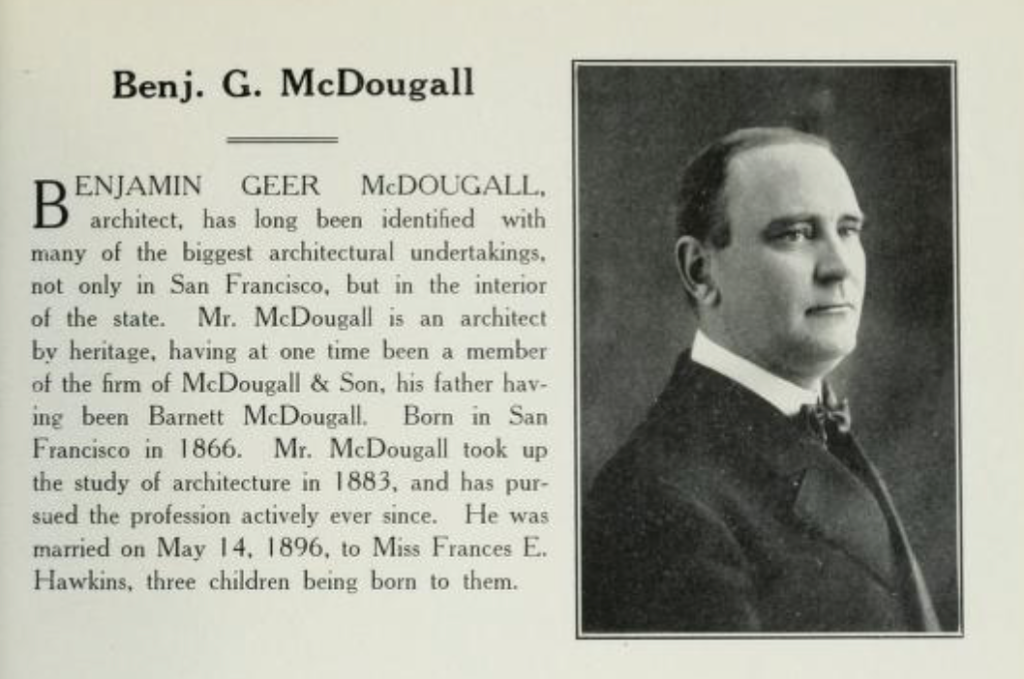
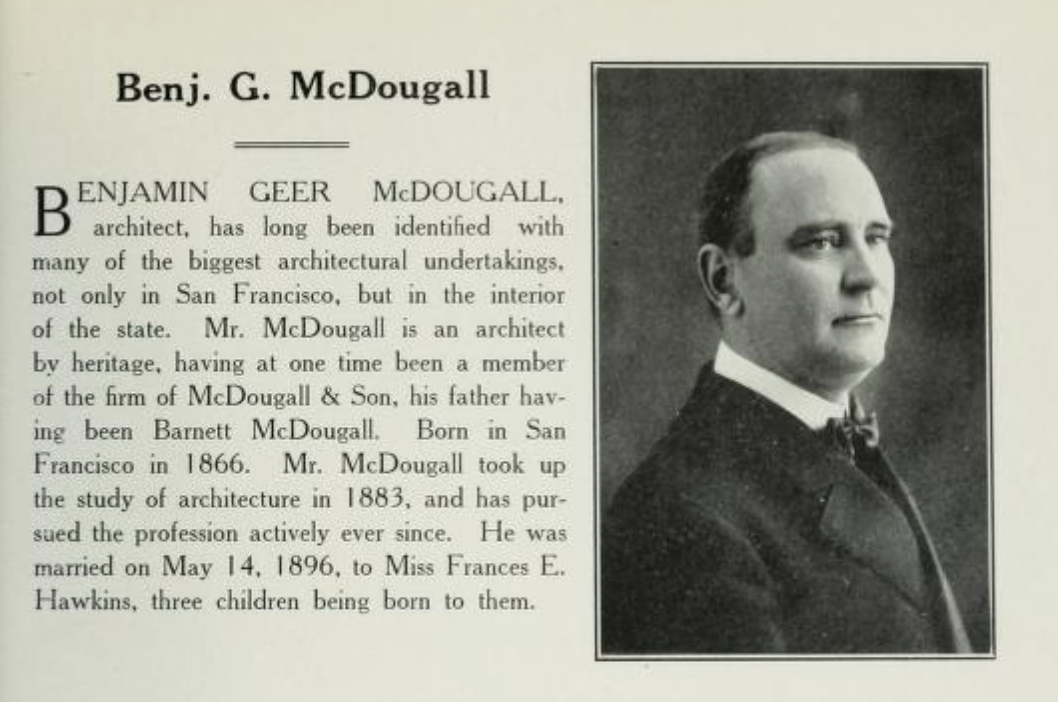
The 1907 committee to plan and construct the new elementary school building searched for an architect the tax payers could afford. They found an experienced young man who had just opened his own practice and was eager for commissions. Benjamin McDougall was forty two years old, born in San Francisco,
By Sharon Marovich for the Union Democrat. Read this article on. When the Sonora Grammar School was completed in the fall of 1909, the elegant, white building graced with eight tall Tuscan columns and a silvery dome was an instant landmark. Ensconced on a hill three steep blocks above the

Historical Significance

The Dome is eligible for listing on the National Register of Historic Places. both in it’s own right and as a contributing element of the a potential residential historic district of Sonora.

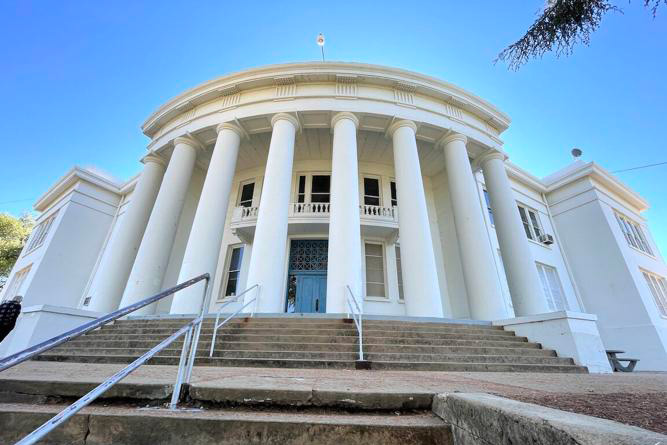
The building is eligible for listing at the local level for its association with the economic and social development and growth of Sonora in the early 20th century. The building has long been a local landmark, and is visible from throughout much of the town on its hilltop location. The building embodies the distinctive characteristics of a Neoclassical style building from the time period. The full-height colonnade and classical architrave and frieze are defining features of the Neoclassic architectural style.

The building has no exterior alterations and continues to display the original design and appearance of the style. It conveys the growth and regional importance of Sonora in the 29th century, and is associated with the lives of several locally prominent individuals and families.

Our Mission

One characteristic of a thriving community is the presence of a thriving arts and culture community and veneration of the past. Enthusiasm for the arts, culture, and history is a metric of social vitality and economic growth, and a display of energy and abundance.

The Historic Dome Preservation Group intends to acquire the building known as the Dome, and rehabilitate the beloved but derelict building to be opened as an arts and cultural center for the enrichment of Sonora, Tuolumne County, and the region. The revitalized Dome will provide space for classes in the arts, performance space, cultural heritage space, and an art gallery with a permanent collection of locally created art. The new Dome will be a point of community pride, creative exploration, and forward vision.

Our Vision for the Dome

In a time of major cultural change, recognition of achievement and preservation of historical landmarks is arguably more critical than ever. Our societal norms are in flux and the rate of change unprecedented.

The ability of future generations to understand the past has been somewhat compromised by the undervaluation of history. But we still have the tools and the intellectual capacity to recognize the importance of what has gone before and what that portends for the future.

Preserving beautiful buildings of the past is one tangible way to demonstrate the importance of retention of structures which are no longer constructed because of cost and new concepts in design. Few buildings outside of federal and state capitals have the unique feature of a dome atop the structure.

Today there is no other historical school building of this architectural design in the Mother Lode region. Totally unique, it was opened in 1909 and dedicated to education, standing as a monument to good traditional architecture and a continuing commitment to learning. Today, there is no other building of this kind in any surrounding areas. Saving the Dome would not only ensure the preservation of this unique structure, but also provide a central location for community arts and education for future generations.

Given its unique qualities and singular style for the region, it is also recommended to have the structure designated as a national historic place. This formal designation is from the National Register of Historic Places. An application process is involved with the property under consideration evaluated for meeting criteria including age, integrity and significance of the structure. The age and integrity standards require that the building to be over fifty years old and to retain much of its original appearance. Significance issues relate to architectural, engineering innovations, uses of the building and overall role in the community. The Dome can meet these criteria. The process is approximately a 90 day time period. Some of the advantages of the listing include, but are not limited to; eligibility for preservation grants which may incorporate investment tax credits, building code fire and life safety code alternatives and preservation easements to non-profit organizations.

The Mother Lode region is rural with beautiful landscapes and significantly, a very active community dedicated to the arts. The building, once upgraded and in compliance with appropriate building and safety regulations would be a mecca for teaching and an excellent venue for the performing arts. Despite all the talent in the area, there is always a dearth of locations able to house audiences for musical events, plays, small productions, etc.

This appetite for cultural events stems from those who have grown up here as well as transplants especially from the Bay area, who enjoy these events without the necessity of a long commute to Sacramento or San Francisco.

The Dome’s size would sufficiently accommodate, galleries, a museum and teaching facilities with an emphasis on the arts and local cultural heritage. It could also house a cultural center for Me Wuk tribal artifacts and history displays. The Me-Wuks have been a vital and active part of the community and their important role will be highlighted in the proposed cultural center. Columbia College and local high schools would be enabled to offer classes convenient to Sonora. Classes could include, but certainly not be limited to; theater, film, dance, music, ceramics, spinning and weaving, and radio production. The Dome auditorium would provide a stage for writers and story-tellers looking for a venue for holding classes and performances.

Both historically and presently, there has never been a center for the arts anywhere in this geographic region. The Dome is well suited to become that center. Given its original use as a school, it is more than capable as serving as a focus for the arts in surrounding communities. The building could also house a small museum store, cafe, and serve as a gathering place.

With facilities for culinary arts, the planned preparation kitchen arrangement could accommodate dinner events combined with performances or other special occasions. The auditorium offers a uniquely attractive location for such events, as do the ground level, outdoor terraces.

Perhaps, the best way to define the vision is the development of an alliance of both public and private organizations dedicated to training, learning, promotion of the performing arts and serving the public in those endeavors that offer cultural enrichment. The potential involvement of the two local Native American organizations, the public schools, Columbia College, the Tuolumne County Art Alliance, the Sonora Bach Festival, the Visitors Bureau, the Tuolumne County Film Commission, KAAD-LP radio station, the local Chambers of Commerce, the City of Sonora Event Planning, could constitute a full schedule of events, enhancing the community’s art and cultural programs, and would also be a source of revenue to sustain the center.

Other sources of revenue would include rental of space for providing classes, executive offices for various agencies, and dedicated space for meetings and community events. Performing arts would yield revenue from the sale of refreshments, and ticket sales for special dining events and art exhibits. Rental of the auditorium would also be a significant revenue source.

By saving and restoring the Dome to its former beauty and achieving compliance with current building and safety codes, an opportunity is established for future generations to come and participate in artistic endeavors in an environment that is a tribute to history and the spirit of creativity.

The Little Old Red Schoolhouse on the Hill

by Teresa A. Mallard

The site where now stands the Sonora Elementary School dates back long before my time. In the year 1882 I “started” school with Mrs. Adelaide A. Miller as my first teacher in the “little room” of the old red brick school. We learned our ABC’s in little straight back seats, and were happy when we could quietly play outdoors under the watchful eyes of our motherly teacher.

Hanging from the ceiling inside the room was a rope which, under hand, rang a bell for recess and dismissal of the school. The little folk were dismissed at two o’clock; then Mrs. Miller taught a class in geography in the afternoon.

In the “big room”, connected to the “little room” by a door, we advanced to further study. In there, two students could sit at a desk, though with no room to spare.
This comprised the Sonora Grammar School in 1882. Later when it became necessary, a small wooden building, detached from the one of brick was added and two teachers installed. Still later, a lager, one was built on top of the grade in the same lot and we were allowed to play up there. When the “in recess” bell rang, we ran at top speed to line up for marching into school to the accompaniment of the principal, Miss Maggie Fahey. Who tapped on a hand bell. We could not talk or move out of line. When we had an organ, I played for marching and singing, while another girl, “pumped” to keep the music going.

There were not “grades” in our school – just “classes”. As we progressed our final years were in the “big room” with Miss Fahey, the one teacher of the “first class” the “first division” and the “advanced class”.

To graduate, it was necessary to appear before the County Board of Education and take the same examination as those aspiring for teachers certificates, the only exception being a very few subjects in higher education. When I won my diploma, examinations were conducted at small tables in the Turn Verein Hall. We had no graduation honors.

Miss Maggie Fahey taught in this school a half century, from primary teacher to principal-ship, and was highly regarded for her keen mind, firm leadership and understanding nature. Pupils I remember, who later were co-workers of hers as teachers were Ora Moss Morgan, Rachel Shaw Watson, Maude May, Pearl Hoskin Murrow and Gussie Symons Splain.

We had no janitor in those days. Each teacher was responsible for the upkeep of her room. In cold weather, a boy assigned for that purpose would put wood in the stove for heat. Boys carried water from Divoll’s well at the foot of the long hill. Monitors went along the rows in school. All dipped from the same long-handled dipper.
A soft spoken voice was trained by Miss Fahey. She would stand at an open window until such time as the reader’s voice would clearly carry from the yard below.

For whispering in school, we were fined points, which was deducted from our credit rating. For other violations, we sat on the boy’s side of the room. For chewing gum, the offender had to “stand up front” holding the gum in his outstretched hand!

On Friday afternoon we “spoke pieces” and had literary programs. We also edited a school journal of essays and poetry.

We gave several creditable public performances at the Opera Hall. An outstanding musical cantata of flowers comes to mind; by request, it continued two nights.
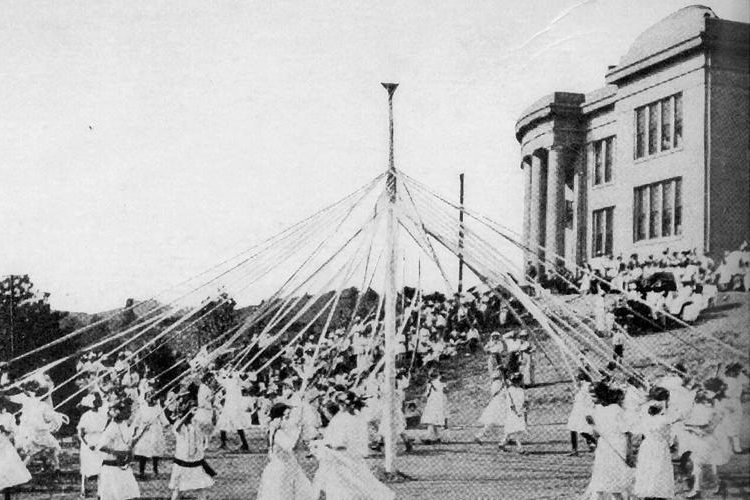
School picnics were held at Kentucky Flat, a beautiful spot across from the home of Miss Fahey. There was always a king and queen crowned midst maids of honor and pages, lovely wild flowers and singing birds. A Maypole Dance was held with music by Eugene Goffinet play on a harmonica.

There were huge swings to “pump high” from the limbs of sturdy shade trees and games to pass the time away.

Mrs. Rebecca Lick made and served her famous ice cream and candy, and Tom Leonard provided us soda water from his factory.

Teachers and children in the early morning formed a long line and marched up the length of Washington Street and down and out the ditch trail. Whole families walked that distance. Their lunches were spread on cloths on the green grass and all sat around. That night a big dance was held in the Turn Verein Hall, with the king and queen leading the grand march.

“On Decoration Day” (we always called it that), we marched with band music to the cemeteries and placed flowers on the soldiers’ graves.
Every national holiday, we paraded from the school up the length of the main street, counter marched through the Bauman Brewery, and returned to school.

From the City of Sonora Web Site “Historic Landmarks”

The wood building was on Barretta St at Gold St. The red brick building north of the wood building was acquired in 1907. The need for a new, larger building was soon apparent and planning for the Dome building began. A bond measure was passed for $50,000, and the building was not to exceed $35,000. A group of Los Angles banks and Mr. C. A. Belli, president of the First National Bank of Sonora purchased the entire bond offering. Mr. Belli’s son later attended school in the Dome building.

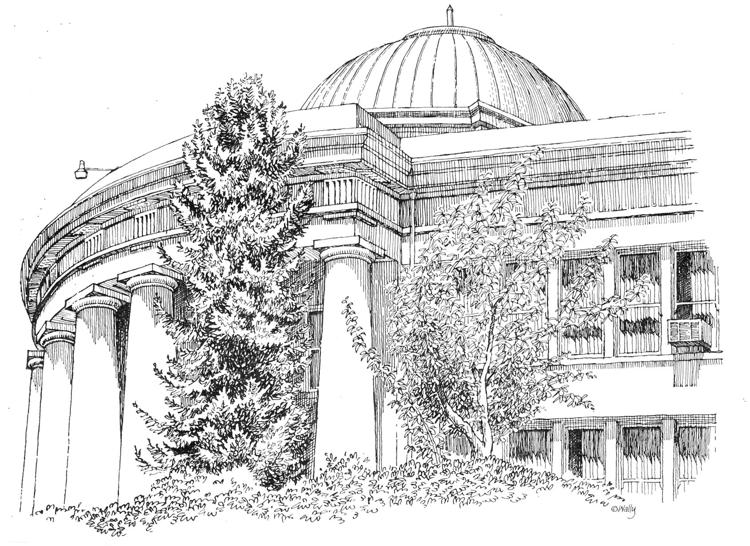
Mr. McDougall’s design resembles the United States Treasure Building in Washington, D.C. and was made public in September of 1908. The design was for a two-story Neoclassic concrete structure, with an eight Tuscan-style column portico that extends tow floors from the entrance level to the roof. The columns are topped by an architrave and classical cornice that continue to the right and left along the wings. The dominate feature of the building is a silver colored dome centered on the roof above the entrance portico. Entrance to the building is through a set of two wood-paneled doors, under a 32 light transom. Above the entrance is a decorative balcony and railing, protruding from the second floor auditorium space. The interior featured Oregon pine floors, metal lathe and plaster walls, and hard wood finishing. Each classroom had a wood stove for heating and oil lamps were attached to the walls between the windows for light. As the children returned from recess out side, they were required to pick up a piece of fire wood for the stove.

The wood schoolhouse was reluctantly demolished and construction of the building was begun on that site. The school house building served double duty until the Dome was opened in September of 1909.

The architect, Benjamin Mc Dougall, became a well known architect in California several years after designing the Dome building.

Gravel was brought up from what is now the treatment plant, to the building site by mules, driven by Mr. Dambacher

Other classrooms and what is now Dario Cassina HS were built in the early 1950s. The Dome was abandoned on june 12, 1967 and classes were continued in portable buildings until the new Sonora Elementary campus was opened in 1973. The bell was move.

In 1909 the first color movie was shown in the Palace Theater in London.
William Howard Taft was President.
Construction of the Titanic was begun in Belfast, Northern Ireland.
Selma Lagerlof was the first oman to win the Nobel Prize for Liturature.

Joe Nikrent won the first AAA Club automoble race from Los Angles to Phoenix in a Buick.

Building Plan

A detailed plan for the use of the more then twenty thousand square feet of space in the renovated Dome building, will be developed by our architect and structural engineer. A guiding principal for the development of this plan is that the building must be financially self sustaining as much as is possible. The museum, art gallery and related activities will be supported by income generated by productive use of the floor space not occupied by the museum and art gallery. Our business plan will be an essential guide for development of a final floor plan.

Currently, we have a general plan for the interior use of the building.

The basement level will primarily remain as classroom space. Ideally, these classrooms would be rented by Columbia College as a satellite campus. The college provided a variety of classes at various locations in the Sonora area. The classrooms in the basement of the Dome would be a convenient location, with adequate parking and dedicated rooms for the Columbia College classes. Space not occupied by the college would be available to individuals, churches, and other groups for classes or meetings. The KAAD-LP radio station could remain in its present location, and there is also space that could be rented for storage. In addition, a small preparation kitchen will be available to facilitate events in the building.

The first floor will be the museum and art gallery. Space will also be set aside for an administration office and for a future gift shop and cafe.

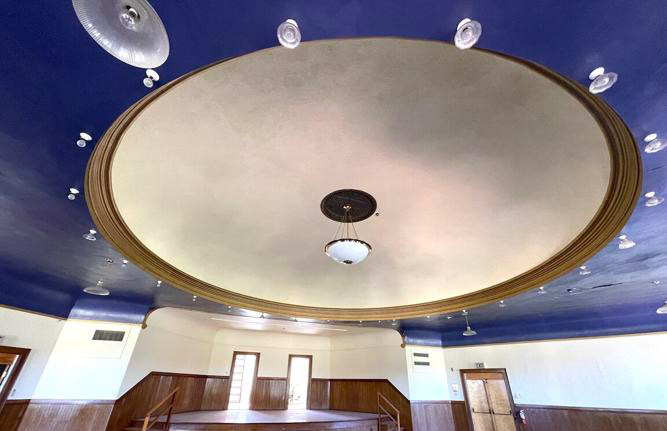
The second floor features an auditorium with a small stage to be used for lectures, movies, and concerts. The auditorium is a wonderful location for luncheons, meetings, social events and mmm. The remaining space on the second floor will be available as professional office space.

The basement level and second floor will be income centers to support the first floor museum and art gallery.

Building History

In 1882 the people of Sonora realized that their town was more than just a dusty mining town, and like any respectable metropolis they needed a public elementary school. So they acquired some land and buildings above the town on Barretta St. and opened the Sonora Public Elementary School. The number of children needing education kept increasing, as they often do, so that by 1906 the school consisted of four buildings; a red wood building, a red brick building, a white wood building and the neighbor’s hay loft of indeterminate color. The second grade children learned to read and write accompanied by animal sounds from the barn below the loft. There was a cupola on the roof of one of the buildings and a bell was installed to call the children to school. The townspeople could set their watches by the tolling of the 8 o’clock school bell.

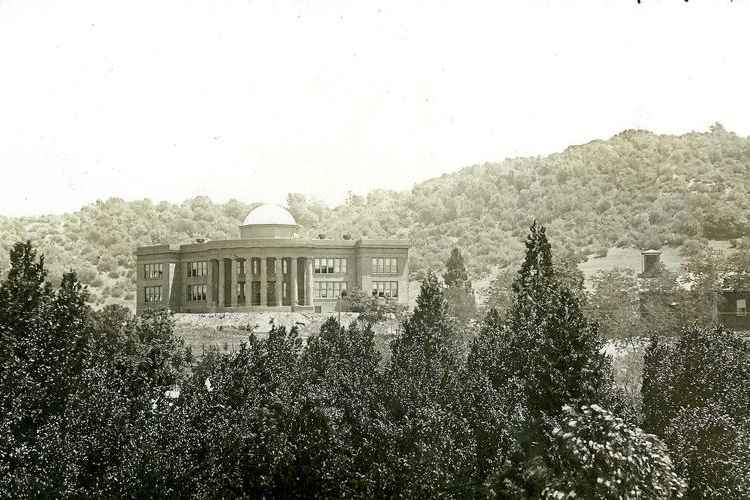
SHOW OLD PHOTOGRAPH OF THE DOME

In 1907 it was again necessary to expand, so the School District issued bonds to raise $50,000, and began the planning of a more substantial structure. In 1909 the building we know as the Dome was opened for class, and the bell was move to this new building. However, in the 1960s it was determined that the Dome did not meet the State standards for seismic survivability for an elementary school and a new, modern school campus was planned. The new elementary school on Greenly Rd was opened in 1968 and the bell was moved from the Dome to where it is now encased in a red brick wall at the entrance to the school.

SHOW PHOTO OF THE BELL

The Sonora Union High School District purchased the Dome, other buildings, and surrounding land, from the Sonora Elementary School District in 1973. The Dome was then used as the District Superintendent’s office and also as the Tuolumne County Schools office. But, by 2010 both the Sonora Union High School District and Tuolumne County Schools had move out and the building has been essentially empty and neglected since then. There is currently only one room in the basement being occupied. This is the studio and transmitter room for the KAAD-LP public radio station. The Tuolumne County Historical Society also rents a few rooms for storage and several other rooms are used by the High School District also for storage.

The Sonora Union High School District designated the Dome building and the two classroom wings north of the build, as surplus property in February of 2018 and again in August of 2022, making these buildings eligible for sale or lease.

SHOW OVERHEAD OF SURPLUS PROPERTY

Benjamin McDougall, Architect

The 1907 committee to plan and construct the new elementary school building searched for an architect the tax payers could afford. They found an experienced young man who had just opened his own practice and was eager for commissions. Benjamin McDougall was forty two years old, born in San Francisco, and had spent several years working with his father and brother in his father’s architectural firm. His design for the new school featured a classical entrance with eight impressive, ground-to-roof columns and a commanding silver dome on the roof. The front of the building has been compared to the United States Treasury Building in Washington D.C. However, Mr. McDougall’s design was unusual in that the north and south wings of building are off-set at a slight backward angle, from the columned portico.

Mr. McDougall went on to some fame in the Bay Area and leaves a legacy of several buildings in Oakland and San Francisco, among them is the Standard Oil Building in San Francisco and the Federal Reality Building in Oakland, also known and the Cathedral Building, the West Coast’s first Gothic Revival skyscraper.

Buildings you may be interested in, designed by Benjamin Geer McDougall:

  • Hanford Carnegie Library 1905
  • Merced Security Savings Bank 1905
  • (Goodwill Ind.) Oakwood Hotel (rebuilt Waldorf Astoria) 1907
  • Standard Oil Bldg Bush and Sansome SF
  • St. Luke’s Episcopal Church SF
  • St. Paul’s Episcopal Church Oakland
  • Sheldon Building 1907
  • 9-15 1st. St. San Francisco
  • Shattuck Hotel 1909

Reevaluated by Bridget Maley Architecture + History LLC Feb. 2013
Evaluated by Franklin Maggi Archives and Architecture, LLC
P. O. Box 1332 San Jose 95109-1332 May15, 2015

How the Sonora Dome became an instant landmark

By Sharon Marovich for the Union Democrat.

Read this article on.

When the Sonora Grammar School was completed in the fall of 1909, the elegant, white building graced with eight tall Tuscan columns and a silvery dome was an instant landmark.

Ensconced on a hill three steep blocks above the heart of the Queen of the Southern Mines, it is still revered as architectural royalty. Visible from throughout central Sonora, it is often mistaken for the town’s courthouse or city hall.

This majestic building represented a community’s continuing commitment to the promise of younger generations, the considerable talent of a San Francisco architect with important works still ahead and a populace solidly behind both, financially and in spirit.

That particular knoll on South Barretta Street is the site of the town’s first permanent public school, a red brick edifice that opened in September 1858.

The earliest school board brought public education to Sonora’s growing school-age population as early as 1855 in a rented facility. Previously, private schools and home instruction had taken root in the tumult of the Gold Rush, when there were few children to educate, and they continued for some time.

As early as March 1853, textbooks on such subjects as arithmetic, geography, and spelling were available at Sonora’s Miners’ Book Store, an oasis of enlightenment amid the vice and violence of mining camp days.

The number of school-age children continued to grow as families settled here, and trustees added a wooden classroom building in 1875. Two years later, they were filled with 264 students. Although they numbered less than a dozen and a half, that tally included children of Asian, African American, and Native American ancestry, some of whom had been denied an education with their peers until a California Supreme Court ruling in 1874 opened the state’s public schools to all children.

It was about this time that Margaret A. (Maggie) Fahey joined the faculty as a primary grade teacher. She advanced to principal 13 years later in 1888 and is generally credited with bringing order and discipline to an administration and student body somewhat lacking in both.

Fahey was considered the school’s heart and soul until her death in August 1921. She was a graduate of the old brick schoolhouse and spent her career on the hill, as did a remarkable number of other pre- and post-Dome alumni.

In the 1890s, the Mother Lode’s mines were in bonanza again as a second Gold Rush swept through the region. Fueled by investors from around the world and also made possible by new technology designed to get the gold the 49ers left behind, Tuolumne County’s economy was booming again.

Two new industrial-sized lumber companies tapping the rich timber resources of primeval forests and expanded livestock raising added significantly to the mining excitement, which saw the arrival of the Sierra Railway at major depots in Jamestown, Sonora, Standard, and Tuolumne beginning in 1897.

This economic re-awakening brought Sonora the first-class Hotel Victoria (Sonora Inn) (1896); courthouse (1899); Bradford Building (Vault Candy Store) (1903); first high school (1906); a private hospital (1909) and neighborhoods overflowing with showy late Victorian-era homes.

This golden opportunity to replace an aging campus and provide for a growing student population was not lost on district trustees, prominent citizens at the time: Dr. R. Innis Bromley, Frank Ralph, and Ed Rehm.

Bromley was a popular physician/surgeon who arrived in Sonora in 1887 from the East Bay. His practice was located in the Bradford Building before he moved it to a hospital/sanitarium designed by the Dome’s architect while he supervised the school’s construction. Bromley was an old fashioned country doctor and spent many hours in his buggy en route to patients unable to visit his office.

Ralph was a native son who grew up on a farm along Sanguinetti Road established by his father, Jonathan Florentine Ralph, in the Gold Rush. He was a successful wheelwright and orchardist who was a member of the town trustees (city council) while serving on the school board. His career in elected office culminated in election to the county Board of Supervisors from District 1 in 1920.

As a county supervisor, Ralph designed Courthouse Square and oversaw its installation in 1936. He also worked with Gilbert Ashley, architect of the Sonora Veterans Memorial Hall (1932). For both projects, Ralph successfully incorporated Columbia marble into their designs. Following his death in 1941, the park was dedicated to his memory with a monument along West Yaney Avenue made of stones gathered throughout the county.

Rehm, a Columbia native, was the owner of a successful clothing store catering to men, women and children located on South Washington Street (today’s Thirsty Prospector). As a well-known early “Kodaker”, he was a cofounder of the Sierra Amateur Camera Club in 1900. He was also a director of the Tuolumne County Bank.

In early 1907, the three men began discussing the idea of calling a bond election for funds to replace the school facilities that The Union Democrat described as “a group of old rookeries…that have outlived their usefulness… and are a disgrace to the school department.” The newspaper also called them “dangerous, unsanitary and inadequate.”

Voters apparently felt similarly, and voted 227-44 at a June 8, 1907, election to support a $50,000 ($1.64 million/2023) bond issue for a new campus for students then numbering about 350.

A Los Angeles firm, N.W. Harris and Co., agreed to buy the bonds, but later withdrew its offer as its attorney advised the ballot measure’s wording was confusing and could be misinterpreted, though Sonora’s voters seemed to understand its intent. After a year’s delay, trustees — working with the county Board of Supervisors — announced that a bond sale deal had been worked out with the First National Bank of Sonora.

With funding in place, they advertised for an architect to put together plans and specifications for a single new building. Nine California architects vied for the Sonora job in a design competition finally decided by the board at 2 a.m. on a hot August night in 1908.

Benjamin Geer McDougall’s rendering, echoing the grace and beauty of Greek and Roman architecture, won the day for his San Francisco firm.

Drawing heavily from design traditions 2,000 years old, McDougall’s curving array of gently tapered columns, two flaring wings, a smooth white finish and a silver dome above are architectural elements that continue to lend the building distinction and timelessness. It remains a local legend that his inspiration was the United States Treasury building in Washington, D.C.

McDougall’s interest in bidding on the Sonora school project may have been piqued by his firm’s unsuccessful foray in Tuolumne County 10 years earlier. It was among 10 bidders vying for the contract to design, furnish and supervise construction of the Tuolumne County Courthouse. In January 1898, the county Board of Supervisors awarded the job to a competing San Francisco firm, Wm. Mooser and Son.

The board’s decision was apparently as contentious as the school board’s debate that lasted into the early morning hours. It wasn’t until 3 a.m. that the supervisors, in a 3-2 vote, could come to a decision. And, like the Dome commission, it resulted in a second project for the architect: design of a new home for Supervisor Thomas Hender, an 1899 Colonial revival mansion that still stands on North Stewart Street just south of Elkin Street.

McDougall’s additional Sonora job was a sanitarium-hospital for Bromley (1857-1930). Located in downtown Sonora (northwest corner of South Washington and Church streets), it was built of reinforced concrete like the school and had two stories and a basement, also like the school. It stood until the 1950s, when it fell to make way for a used car lot, part of an adjacent automobile dealership in a building now occupied by Yosemite Title Co.

McDougall’s plot plan shows nine classrooms, offices and a second floor auditorium or assembly room directly beneath the dome. In a design flourish, he added a dome to the ceiling of the 450-seat space. It is interesting to note that the superstructures of the rooftop and auditorium dome are two separate installations.

When McDougall joined his father’s pioneer architectural firm in San Francisco, his two brothers, Charles and George, were already partners, though they did not have the formal education their brother acquired at the San Francisco School of Design.

At some point, the firm opened an office in Bakersfield where oil fields were booming, and Benjamin McDougall ran it until it was relocated to Fresno. The firm’s work in the Central Valley included the Kings County jail in Hanford (1898); Carnegie libraries in Visalia (1904) and Hanford (1906) and banks in Merced (1905) and Visalia (1905).

Seeing opportunity in San Francisco following the earthquake and fire in April 1906, Benjamin McDougall opened his own office there and another in Berkeley. When tapped for the Sonora job, the architect was in the midst of a near half-century career applying his considerable design and construction skills to a wide variety of jobs: office buildings, churches, homes and even an iron works in Berkeley.

Although his St. James Episcopal Church in Los Angeles (1922) with its soaring gothic arches and medieval nave is impressive; it is his French-Renaissance-inspired federal building in Oakland that is considered his finest work. Located on a wedge-shaped parcel at 16th and Broadway, this creamy, terracotta-clad flat iron followed by only four years of construction of the Dome. At 13 stories, it still stands 110 years later as one of the West Coast’s first high rises.

Benjamin McDougall was a resident of Berkeley, living near the Claremont Hotel, when he died on June 11, 1937, at 72.

In Benjamin McDougall, the Sonora school board found a man who could easily carry out its vision for a building that symbolized its dedication to quality education, permanence, and the commanding presence the hillside location demanded.

An excellent account of the Dome’s progress from rendering to reality is part of a chapter on local education in “Historic Sonora” by the late Carlo M. De Ferrari, Tuolumne County’s longtime official historian, who wrote that it only took Benjamin McDougall four months to complete blueprints and construction specifications.

In January 1909, the Fresno firm of Baley and Simpson was awarded a contract to build the school on a low bid of $32,698. A separate contract for a steam heating system went to Morgan and Co. of San Francisco at $2,600.

Existing school buildings housed students for the duration of construction. While excavation was underway for the basement and foundation, the board purchased an adjoining acre for an expanded playground and added more land in the years to come.

An important sign of progress was the laying of the cornerstone in April 1909. Festivities involved a parade of students and organizations through downtown to the school, a 21-gun salute, and speeches.

The granite block encasing a small wooden box was moved to the school’s new campus on Greenley Road in March 1973, but for 64 years it held memorabilia that included four newspapers of the day, photographs, a scroll listing the names and ages of all students in 1909, coins, and a program of the day’s events.

A month later, the walls were completed to the second story and the building’s character-defining colonnade had nearly soared to its proper height, giving “a good idea of the impressive architectural beauty of the structure when completed,” wrote the Tuolumne Independent Newspaper.

Inside plastering was finished by late October, and the smooth outside finish — coated with white paint — would be completed in another three weeks.

New desks and other furniture were in classrooms and offices by mid-November. By then, sixth- and seventh-graders had worked together to purchase a picture of Yosemite for the assembly room. Students also helped raise funds for new playground equipment by putting on drama productions.

The school, which had become the talk of the town, opened to 335 excited students, faculty and staff just after Thanksgiving 1909.

With progress came demolition of the pioneer schoolhouse of 1858, but some of its bricks live on in buildings and gardens in Sonora. At least one blackboard became a tabletop for an Italian family, which found its wooden surface ideal for pasta-rolling. One of two wooden buildings was sold at auction for $205 to John Rother, who constructed it in 1890.

The class of 1910 was the first to graduate in the assembly room from a permanent stage and under the decorative ceiling directly below their new school’s spectacular feature.

The impressive concrete wall along the South Barretta Street frontage followed, and landscaping emphasizing lawns and many evergreen trees such as cedars and redwoods soon appeared. Though spelled differently, Barretta Street is named for Jacinto Barreto, a Gold Rush merchant.

The student body was treated to annual picnics at Principal Fahey’s Kentucky Flat ranch on Campo Seco Road, and dancing around a Maypole was a rite of Spring.

As enrollment increased over the years, the campus gained athletic fields and several buildings: a two-classroom kindergarten unit and two first-grade classrooms just north of the Dome; a multi-purpose room and upper grade complex of four classrooms; and a hall to the south.

By the mid-1960s, enrollment reached a bulging 738, and the school board’s thoughts turned to the recommendation of a citizens’ committee to build a larger campus.

Strict Field Act earthquake standards and inspections by the State Fire Marshal led to abandoning the Dome for classes in 1967. Portable buildings, augmenting some already in place, were brought in and covered most of the paved playground areas.

It took considerable assurances from the board to quell “Save the Dome” sentiments, as one proposal was to demolish the beloved building for new classrooms. After nine tries, voters passed a bond issue on May 13, 1969, assuring a brand new, state-of-the-art school on Greenley Road, on portions of two former dairy ranches.

Red brick veneer was used extensively throughout the new facility and is a cultural tie to Sonora’s first red brick schoolhouse of 1858.

The last students attended school in the educational icon 56 years ago, only two years less than the 58 years it was a hotbed of learning for several generations of learners.

The Sonora Union High School District, owner of the entire South Barretta Street Campus, is preparing to sell the Dome and the two classroom units to the north in a public sale pending the completion of an appraisal.

“The historic Sonora Dome is one of the best examples of early 20th century public schools in California,” according to a professionally-prepared feasibility study from 20 years ago.

At 114 years young, it needs some TLC, as the study noted, but with 21st-century imagination, know-how, and determination, this place can continue for years to come.